



Premium Scholarship | Translated by Bao Tong & Zhang Songzhuo: The Evolution and Challenges of Broadcasting Research in Japan
2026-01-20
browse:581
2026-01-20
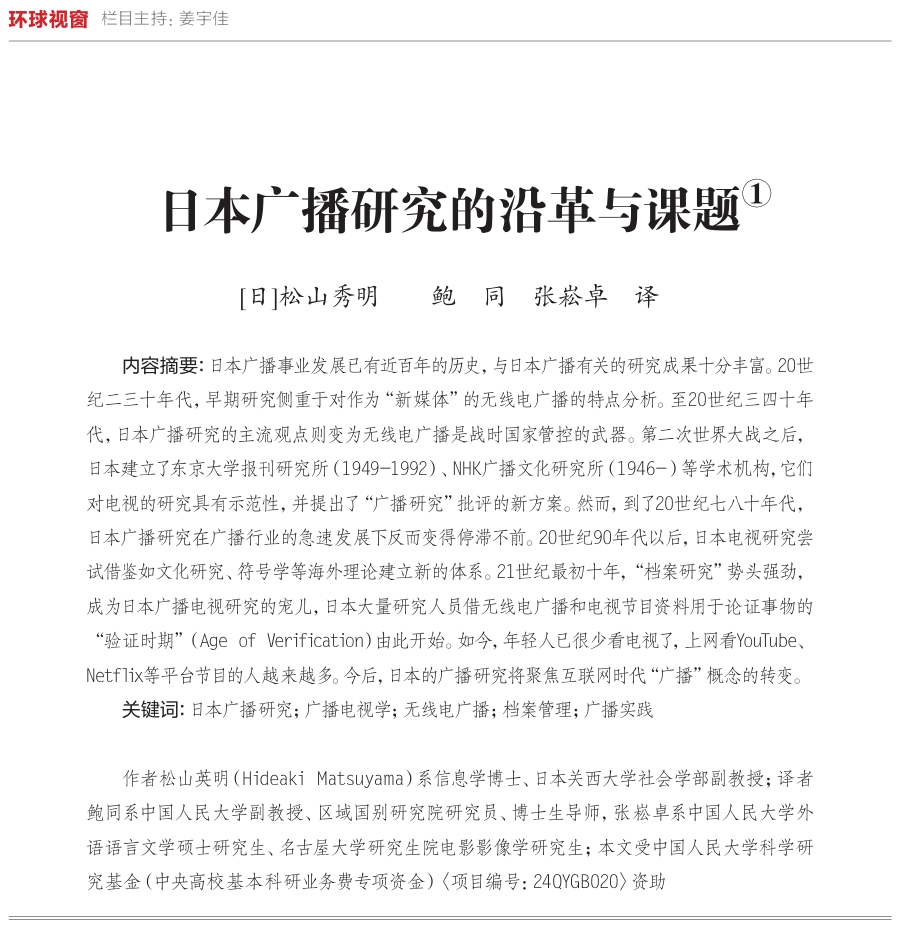
The History and Challenges of Broadcasting Research in Japan
Translated by Bao Tong & Zhang Songzhuo
Japan’s broadcasting industry has a history spanning nearly a century. From the 1920s and 1930s, when research focused on the characteristics of radio broadcasting, to the 1930s and 1940s, when broadcasting was used as a tool of state control during the war; from the post-WWII proposal of new critical approaches to “broadcasting research,” to the post-1990s attempts to build new frameworks by drawing on overseas theories—studies related to Japanese broadcasting have developed over a hundred years, yielding a rich body of research.
This paper, originally written by Japanese scholar Hideaki Matsuyama and translated by Associate Professor Bao Tong (Research Fellow at the Institute of Regional and Country Studies, Renmin University of China) and Master’s candidate Zhang Songzhuo (Department of Foreign Languages and Literature, Renmin University of China; Graduate School of Film and New Media, Nagoya University), provides a detailed overview and analysis of the historical development and key issues of Japanese broadcasting research.
I. Japanese Broadcasting Research Before and After World War II
(1) The Beginnings of Radio Research in Japan
Shortly after the establishment of Japan’s first radio station, the Tokyo Broadcasting Station (Tokyo Hoso Kyoku) in 1925, Takashi Murofushi published an article titled “The Principles of Radio Broadcasting Civilization.” In it, he argued that while newspapers comment on “yesterday,” radio comments on “today,” and proclaimed that low-level civilization was a thing of the past, replaced by a “higher civilization” represented by radio. From the very beginning, Japanese broadcasting research treated radio as a medium of a new civilization.
Before World War II, the main platforms for radio research were journals published by NHK (Japan Broadcasting Corporation), such as Survey Monthly (1928–1931), Survey Times (1931–1934), Broadcasting (1934–1941), and Broadcasting Research (1941–1943), which featured numerous review articles. For example, Eizo Koyama of the University of Tokyo’s Newspaper Research Institute elaborated on radio’s characteristics of “temporal synchrony” and “spatial co-presence,” arguing that radio was “the best cultural tool for minimizing or overcoming differences in time and space” and that the radio world constituted a “four-dimensional world” combining time and space. Around the same period, Hideo Ono discussed the unique properties of radio waves through comparisons with newspapers.
Early articles in these journals covered theoretical research on radio in news, art, rural broadcasting, school broadcasting, and public speaking. Yonosuke Gonda proposed a theory of radio as mass entertainment. Many of the arguments developed during this period would later form the basis of post-WWII broadcasting research.
However, as Japan’s aggressive wars expanded from the 1930s onward, most discussions shifted to “how radio could be used in wartime.” In particular, the journal Broadcasting Research (1941–1943) published articles with titles such as “Wartime Broadcasting Propaganda,” “Various Issues in Wartime Broadcasting Programs,” and “The Pacific War and Broadcasting Planning,” and even featured a special issue titled “Total War and Broadcasting.” During this period, Eizo Koyama also turned his attention to radio’s propaganda strategies and its role in educating the Japanese people. He argued that while radio had previously been regarded as “a form of entertainment,” it was now “the most powerful and important device that could be used to sustain the aggressive war.” In 1942, Koyama published The Theory of Wartime Propaganda, and Yoshio Miyamoto published Broadcasting and the National Defense State, devoting considerable space to discussing broadcasting’s so-called national defense mission and policies.
By the end of the war, most of the pre-war research on radio had disappeared. As the critic Kazutoshi Hasegawa worried, radio had become “a tool of the regulated era.” Thus, post-WWII research on television began as a critical reflection on pre-war radio studies.
(2) The Beginnings of Television Research in Japan
In February 1953, NHK launched Japan’s first television station in Tokyo; in August of the same year, Nippon Television Network (NTV) began operations as the first commercial broadcaster. With the subsequent establishment of other TV stations, the focus of broadcasting research shifted from radio to television.
Two institutions played key roles in post-war research: NHK’s Broadcasting Culture Research Institute (BCRI, founded in June 1946) and the University of Tokyo’s Institute of Newspaper Studies (founded in May 1949).
The BCRI was established under the leadership of NHK President Iwasaburo Takano during the Allied occupation. Its founding mission, as described in its 50-year history published in 1996, was to contribute to the construction of a peaceful, cultural society through broadcasting. To this end, it was necessary to use scientific methods to investigate what kind of programs should be broadcast. The term “peaceful” reflected both the context of the BCRI’s establishment and a critical reflection on the errors of wartime broadcasting research. In 1951, the BCRI launched the BCRI Monthly Report (later renamed Broadcasting Research and Surveys), conducting numerous audience rating surveys and program studies, including earnest empirical research on “children and television.” For example, the two “Shizuoka Surveys” conducted in 1957 and 1959 surveyed 3,700 children in Shizuoka City, investigating questions such as “how television viewing time replaced other activities in daily life” and “how television influenced children’s inner worlds.”
The University of Tokyo’s Institute of Newspaper Studies, whose predecessor was the Newspaper Research Office established in 1929, was formally founded during the presidency of Shigeru Nanbara, with Hideo Ono as its first director. Its first research paper on television, “Television as a Mass Medium—A Survey Report,” appeared in 1957, examining the relationship between television and audience psychology, the effects of viewing content and consumption time, and television’s impact on family habits. Later, Toru Takahashi and others published “Television and the ‘Lonely Crowd,’” which conducted a detailed investigation of media coverage of the Japanese Crown Prince’s wedding procession.
The television research conducted by the BCRI and the Institute of Newspaper Studies in the post-war period focused on the “functionality” of television as a mass medium. Whether through short-term or long-term, direct or indirect research, the premise was to investigate television’s “effects” or “influence,” with the aim of analyzing how television shaped “public opinion” through mass communication and scientifically explaining the audience’s “reception process.” Unlike wartime “propaganda research,” this approach introduced the empirical methods of American mass communication research after WWII.
II. The Development of Japanese Television Research
(1) The Rise of Television Theory from a Western Civilizational Perspective
In the mid-to-late 1950s, indigenous Japanese television theory began to take shape, with various perspectives emerging from the framework of multiple civilizations. In particular, 1958 marked an important year for Japanese television research. The November issue of the journal Shiso (Thought) featured a special issue titled “Television as a Mass Medium,” which signaled the formal beginning of localized television research in Japan. The featured articles covered topics such as television and politics, entertainment, education, film, and mass life, which would become central themes in subsequent Japanese television studies. Contributors included scholars from diverse fields, such as Toru Takahashi, Rokuro Hidaka, Michio Inaba, and Takeshi Sato.
In the opening article of the special issue, Kitaro Shimizu wrote “The Television Age,” arguing that television had ended the “monopoly” of writing in communication and that new forms of realistic communication in the television age would drive social change. Also in 1958, the film journal Kinema Junpo published a special issue titled “The Great Television Encyclopedia,” which compiled basic information and reference materials related to television. Additionally, the quarterly journal Quarterly Television Research, supervised by Masaru Iijima and Naoya Uchimura, was founded. Beyond researchers, early television producers such as Shigenobu Umemoto, Aihiko Okamoto, and Tsutomu Wada also contributed actively, discussing television theory.
Two years later, in 1960, the three-volume series Lectures on Modern Mass Communication was published. The second volume, The Television Age, edited by Hiroshi Minami, included his essay “Television and People,” which discussed television’s development from the perspective of parent-child relationships.
By 1958, when these special issues were published, the number of television households in Japan had exceeded one million. This trend continued, reaching 3.5 million in 1959 and 6 million in 1960. As television spread more rapidly than expected, scholars such as Shimizu and Minami discussed it from the perspective of “Western civilization theory,” exploring how the arrival of the television age would affect the masses and lead the development of civilization.
In 1960, the Japan Newspaper Society published its first special issue on “Japanese Television: Current Status and Problems.” Yujiro Chiba examined the Broadcasting Act, and Kikutaro Kanazawa discussed program scheduling, reflecting researchers’ growing attention to the “production process” of television programs. In addition, Ikuo Takeuchi argued that future television research “should not rely on sudden inspiration or vague intuition… but should firmly grasp reality and conduct research based on it.” He criticized the Western civilization-oriented television theory of the time and called for more refined and rigorous broadcasting research.
Subsequent Japanese television research responded to Takeuchi’s call by diversifying into increasingly specialized fields. For example, Norinori Takagi, Michio Inaba, and Tadao Uryu developed “broadcasting industry theory”; Motokazu Sasaki and Toru Yamamoto advanced “broadcasting art theory”; Kanji Hatano and Sanji Nishimoto contributed to “broadcasting education theory”; and Hiroshi Shō and others developed “broadcasting system theory.” These research areas originated from the television studies conducted by the BCRI and the Institute of Newspaper Studies, and while influenced by Western civilization-oriented television theory, they also laid the foundation for independent Japanese research. From this point on, Japanese television research accumulated steadily, and the forefront of mass communication research gradually shifted to television studies.
(2) The Founding and Frustration of Japanese “Broadcasting Studies”
This trajectory of development gave rise to the idea of “broadcasting studies” in 1960s Japan. It was not an academic name established under the influence of Western critical theory or based on various empirical surveys, but an innovative attempt to integrate indigenous Japanese television studies.
In June 1959, the BCRI established the “Broadcasting Studies Research Office,” with Ichiro Nihira as its head and Shoji Fujinuma as a member. Its mission was to explore academic issues such as the essence and philosophy of broadcasting and to promote the formation of a theoretical system for broadcasting research. The research team included scholars with diverse expertise, such as Masaki Sakiyama, Keizo Okabe, Akira Tsujimura, Toru Yamamoto, Yoshimi Uchikawa, and Michitaro Tada.
In 1961, the office launched the journal Broadcasting Studies Research. The following year, it appointed international researchers such as Wilbur Schramm (USA), Paul Lazarsfeld (USA), and Gerhard Maletzke (Germany), and translated their works. In 1963, it further launched the English-language journal Studies of Broadcasting, actively disseminating research overseas.
Keizo Okabe, who was committed to establishing “broadcasting studies,” long advocated for its inclusion within the framework of “policy science.” This approach to television research was not limited to immediate practical purposes but focused on policy-oriented questions, such as why television stations made certain decisions in their broadcasting practices and how such decisions could be supported by rational evidence. Okabe hoped to bridge the gap between broadcasting practice, which emphasized practical interests, and broadcasting research, which had become increasingly abstract and speculative, thereby forming “broadcasting studies” as a “policy science.”
Okabe’s vision for broadcasting studies was not situated within the framework of mass communication research but aimed to establish a new “Broadcasting Studies Association” independent of the Japan Newspaper Society. This initiative was initially promoted within the Japan Newspaper Society, leading to annual symposia on broadcasting research. For example, the 1963 Spring Symposium was titled “Future Directions for Broadcasting Research,” with Kazuhiko Goto and Norinori Takagi presenting key issues and Keizo Okabe, Yoshimi Uchikawa, Rokuro Hidaka, Shunsuke Tsurumi, and others participating in the discussion. The 1964 and 1965 Spring Symposia, titled “Theory and Research in the Field of Mass Communication,” were chaired by Keizo Okabe and Takeshi Sato, with participants including Buriu Takeo, Kanji Hatano, and Ikuo Takeuchi. Scholars who had been engaged in television research gathered to discuss its future direction.
However, the plan to establish a Broadcasting Studies Association was never realized. The development of broadcasting studies stalled after the publication of introductory works such as Introduction to Broadcasting Research (1964) and Prolegomena to Broadcasting Studies (1970), and eventually came to an end. The founders of broadcasting studies were overly preoccupied with defining it as an independent academic discipline, even debating fundamental questions such as “what constitutes scholarship itself,” which ultimately led to its stagnation.
Subsequent attempts to reconstruct the theoretical system of broadcasting research were made by Kazuhiko Goto and Akira Fujitake of the Broadcasting Studies Research Office. Goto published The Theory of Broadcasting Programming and Production (1967), aiming to establish a new critical theory of broadcasting editing. He later published works such as The Editing of Japanese Television Programs and actively introduced Marshall McLuhan’s theories in broadcasting journals, expanding his research to include media theory. Fujitake published The Theory of Modern Mass Communication (1968) and The Theory of Television (1969), conceptualizing television as an “environment” and creating a diagram of the “television communication process.” Although the establishment of broadcasting studies encountered repeated setbacks in the 1960s, this period nonetheless represented an important attempt to construct fundamental theories of television.
The above discussion has focused on the rise and fall of Japanese broadcasting studies within the framework of Western civilization theory, but these activities were largely centered in Tokyo. Broadcasting research in the Kansai region, centered in Kyoto and Osaka, also played a significant role during this period, with Hidetoshi Kato and Tadao Umesao as key figures.
Hidetoshi Kato, while working at Kyoto University’s Institute for Research in Humanities, published numerous articles on television theory, summarizing television’s characteristics as the “routinization of viewing” and providing empirical evidence that program viewing had transformed from a special activity into an everyday practice. Tadao Umesao, while a student at Osaka City University, wrote influential articles on television, referring to those working in broadcasting as “broadcasters” and viewing the broadcasting industry as representative of the information industry. He predicted the arrival of a “spiritual industry era” following the agricultural and industrial eras.
Broadcasting research in the Kansai region was supported by journals published by local commercial broadcasters, such as CBC Report (founded in 1957 by Chubu-Nippon Broadcasting), Hoso Asahi (founded in 1959 by Asahi Broadcasting), and YTV Report (founded in 1959 by Yomiuri Telecasting). These corporate monthly magazines provided platforms for many young researchers and intellectuals to write or participate in discussions. In particular, editors of Hoso Asahi such as Michiko Igarashi played an important role in enabling Umesao and other talented scholars to fully discuss television theory. This intellectual environment in the Kansai region eventually led to the establishment of the Japan Commercial Broadcasters Association’s Broadcasting Research Institute in 1962. Its research outputs included the 1964 report The Theory of Broadcasting Fees and the Radio White Paper, which discussed radio in the television age. These works reflected a distinctive problem consciousness unique to commercial broadcasting research, differing from the research conducted by NHK’s Broadcasting Studies Research Office.
III. Explorations in Japanese Television Research
(1) A Retrospective on Japanese Television Research
As noted above, television research in the 1960s was primarily conducted through articles published by researchers and intellectuals in various journals. In 1967, Broadcasting Criticism (later renamed GALAC) was founded, and Nobuo Shiga began publishing genuine broadcasting criticism in its pages. It can be said that the late 1950s to the 1960s was the most active period in Japanese broadcasting research, largely because the television industry itself had a “bright future.” At that time, television was a “new medium,” so studying television meant studying mass communication and anticipating the future of the information society.
However, in the 1970s, broadcasting research experienced a brief lull. In 1973, Journalism Review published a special issue titled “Twenty Years of Television, Twenty Years of Television Research,” reviewing the previous two decades of scholarship. In the opening article, Akira Fujitake compiled materials on television research, categorizing researchers and their works into sections such as system, industry, programming and production, news reporting, and surveys, thereby providing a comprehensive overview of the field. What began as a “retrospective on television research” became a turning point in the discipline. Notably, the special issue included transcripts of panel discussions. Keizo Okabe, in his contribution, stated that it was necessary to “distance oneself from television and also from television research.” Even Okabe, who had long been enthusiastic about “broadcasting studies,” now advocated moving away from television research. During this period, several broadcasting journals ceased publication; for example, Hoso Asahi ceased publication in 1975, and in its final issue, Tadao Umesao lamented “The Death of Hoso Asahi.”
The call to distance oneself from television research or television theory stemmed from the rapid expansion of television in the 1970s, which made it impossible for researchers to grasp its entirety. As the television industry continued to grow, it became increasingly difficult to study it using a unified theoretical framework. Furthermore, from the late 1960s onward, under the influence of political pressure and incidents such as program cancellations, intellectuals began to withdraw from discussions of television. In 1969, Haruhiko Hagiwara, Yoshihiko Muraki, Tsutomu Konno, and others co-authored You Are Nothing More Than the Present as a form of protest. In 1972, a book titled Has Freedom of Broadcasting Been Destroyed? was published under the name of the “Broadcasting Criticism Roundtable.” Even so, against the backdrop of television’s rapid development and “behind-the-scenes manipulation” in the 1970s, television research fell into a state of stagnation.
In fact, the University of Tokyo’s Institute of Newspaper Studies, which had supported Japanese television research after WWII, published several important works from the late 1970s to the 1980s, including Earthquake Prediction and Social Response (1979), The Current State of Regional Information Media (1981), Disasters and Human Behavior (1982), and Television: The Reality of Local Broadcasting (1983), all published by the University of Tokyo Press. These works were more akin to disaster analysis or regional studies based on information collection than traditional broadcasting research. During the same period, high-quality works such as A Fifty-Year History of Broadcasting (1977) and Hiroshi Matsuda’s Documentary: Postwar Broadcasting History I and II (1980–1981) were also published. It is evident that broadcasting itself had entered a period of historical reflection, and broadcasting research needed a new starting point.
Thus, the vision of systematizing broadcasting theory that had emerged in the 1960s encountered frustration. In the 1970s and 1980s, rather than focusing on constructing a unified theoretical system, researchers emphasized the diversification of research objects and explored corresponding methodologies. They conducted research in their respective fields of interest, examining programs, industries, institutions, and other aspects separately.
(2) Focusing on the Viewer’s Experience
Subsequently, the content of broadcasting research continued to expand, and the renewed attention to the home as a spatio-temporal complex opened up new paths for the field. When the penetration rate of color television approached its peak and the presence of the television set in daily life became taken for granted, the question of how television should exist in everyday life resurfaced. Hideo Kitamura and Osamu Nakano made pioneering contributions by conceptualizing television as a form of social empowerment and emphasizing the need to study the act of occupying daily time through television viewing, as well as the television set itself as an object.
In this regard, Japanese television research was significantly influenced by the emerging field of Cultural Studies in the United Kingdom. Unlike mass communication research, which focused on the “one-way linear relationship” between sender and receiver, Cultural Studies-oriented television research emphasized the multi-layered social processes of encoding by producers and the active decoding by audiences. It attempted to move beyond traditional television research and explore questions such as: What is the “meaning-making” function of television programs in semiotics, given their relationship with producers and audiences? What “power dynamics” are hidden in the daily operation of television as a medium?
In Japan, translations of works by scholars such as David Morley, Ien Ang, and John Fiske (notably his Television Culture) introduced the idea of interpreting “theory” through the “social experience of the audience,” and the translators themselves often became researchers. A series of new television research works soon followed, such as Mamoru Ito and Mafumi Fujita’s Television Polyphony (1999), Naoki Kobayashi and Yoshitaka Mori’s How Television Has Been Viewed (2003), Naoki Kobayashi’s Adventures in Media Texts (2003), Mafumi Fujita’s The Gift, Redelivered (2006), and Mamoru Ito’s The Sociology of Television News (2006). These studies focused on questions such as “what practical meaning can be derived from people’s daily television viewing practices,” analyzing television texts as the product of the interaction between program content and audience experience.
During the same period, research on television from a new “semiotic” perspective also emerged. Drawing on the semiotic theories of Charles Sanders Peirce and Umberto Eco, this approach differed from Cultural Studies and aimed to conduct in-depth research on the structure of television programs. For example, in the introductory article to the Japanese Semiotic Society’s edited volume Deconstructing Television, Hidetaka Ishida wrote a review titled “What is Television Semiotics?” Other works include Hisamitsu Mizushima and Kanji Nishi’s Window or Mirror (2008).
As described above, television research in Japan after the 1990s actively introduced foreign theories to systematize the study of television programs and audiences. In a social context that valued television texts, the popularization of video recording equipment greatly assisted researchers in preserving programs and watching them repeatedly. In 2003, the journal Shiso published its second special issue on television, titled “Reconsidering Television,” covering new topics such as television time and space, semiotics, reality, and audience communities. This was the first such special issue since 1958, 45 years earlier, and served as a detailed review of Japanese television research from the 1990s to the early 21st century.
IV. Examining the History of Japanese Broadcasting
(1) Re-examining the History of Radio Broadcasting
Until now, broadcasting research has largely focused on “broadcasting of the moment.” As broadcasting itself has evolved, research methodologies have also been updated. Since the beginning of the 21st century, broadcasting research has begun to verify “broadcasting history.” As society has entered the internet age, broadcasting has increasingly been discussed as a historical object of study.
Around the year 2000, research on the history of radio broadcasting began to flourish. Works such as Toshiya Yoshimi’s The Capitalism of “Voice” (1995), Isamu Kuroda’s The Birth of Radio Calisthenics (1999), Makoto Yamaguchi’s The Birth of English Language Courses (2001), and Shin Mizukoshi’s The Formation of Media (1993) re-examined the history of radio broadcasting in Japan and the United States in the 1920s and 1930s, particularly questioning the relationship between Japanese radio history and acts of aggression. A series of studies by Akiko Takeyama, such as War and Broadcasting (1994), Broadcasting Under the Pacific War as Told by Historical Materials (2005), and Radio at That Time Under the Pacific War (2013), were also published. In addition, numerous studies have examined the radio broadcast of Japan’s Emperor’s surrender speech, including Akiko Takeyama’s The Emperor’s Voice Broadcast (1989), Yoichi Komori’s The Emperor’s Surrender Broadcast (2003), and Takumi Sato’s The Myth of August 15 (2005). In particular, the “Emperor’s Voice Broadcast” has become an object of historical verification as a key node in Japan’s broadcasting history and post-war history. In recent years, Atsuro Omori has published a series of articles titled “War and Broadcasting,” and Japanese academia has conducted archival analyses of the broadcasting activities carried out by NHK in regions occupied by Japan, such as Northeast China, Korea, Taiwan, and Southeast Asia, verifying the negative aspects of Japan’s radio history through the excavation of new materials. For a detailed overview of such research, see Toshihiko Kishi, Shin Kawashima, and Ahn Seok-jae’s edited volume War, Radio, Memory: Revised and Expanded Edition (2015).
As research on radio history has grown, in 2009 the Japan Society for the Study of Mass Communication published a special issue titled “Reconsidering the ‘Individuality of Radio Broadcasting.’” Hiroshi Ogawa reviewed the history of radio from NHK’s “single-channel radio” before WWII to the “multi-channel radio” that emerged after the establishment of commercial radio stations, and then to the rise of “listener-participatory programs.” In his article, Ogawa also noted the current state of radio research, stating that “researchers’ attention to radio is currently limited to the history of its early days or regional broadcasting, while research on AM or FM radio, which have large audiences, remains scarce.” Radio history research, which has flourished since the beginning of the 21st century, has largely focused on the early days of broadcasting, particularly activities in regions occupied by Japan during the war, but research on post-war radio remains insufficient. Therefore, it is necessary to systematically organize and examine this history.
(2) Re-examining the History of Television
Research on television history has also emerged in the 21st century. In 2003, the Japan Society for the Study of Mass Communication published a special issue of Mass Communication Research titled “The Light and Shadow of Fifty Years of Television.” Since then, numerous monographs on television history have been published, such as Masato Hasegawa and Shoichi Ota’s It’s TV! Everyone Assemble (2007), Takumi Sato’s Television Literacy (2008), Tetsuo Arima’s Thus Television Began (2013), Yutaka Iida’s When Television Was a Spectacle (2016), Seiichi Murakami’s Postwar Japanese Broadcasting Regulation (2016), and Koichi Kinoshita’s The Era When We Learned from Television (2021).
In particular, “television archive research” has officially begun since the 2010s, representing a new development in television history studies. In this context, television stations have improved their program management and information disclosure systems. For example, experimental academic research using NHK’s program archives was launched in 2010, giving many researchers the opportunity to examine television history from its early days. In 2009, Mass Communication Research published a special issue titled “The Possibilities of Media Research Using Broadcasting Archives,” in which Minori Niwa pointed out that improved archive management would bring significant changes to future television research.
Previously, once a program was broadcast, it was rarely reused, and television stations had little awareness of preserving materials. However, if these programs, which have been lying dormant in television stations, are used as historical sources, it could become a catalyst for transforming television research. Since then, through collaboration between researchers and broadcasting institutions, television archive research has flourished, producing works such as the BCRI’s edited volume Broadcasting Media Research No. 8 (2011), Waseda University’s Institute for Journalism and Media Studies and the Broadcasting Program Center’s co-published Interpreting Social Memory Through Broadcasting Programs (2012), and Minori Niwa’s NNN Document Chronicle 1970–2019 (2020). This represents a new attempt in broadcasting research, in which researchers and broadcasting practitioners collaborate to provide feedback to the industry.
Television archive research, which has entered a period of prosperity, can be divided into two directions. The first is “genre history research,” which examines the development of specific program types such as variety shows, documentaries, news, advertisements, and dramas. Examples include Sachiko Ishida and Hiroshi Ogawa’s The Sociology of Quiz Culture (2003), the BCRI’s The People Who Created Television Documentaries (2016), Minori Niwa’s Japanese Television Documentaries (2020), Hiroyuki Inoue’s A Comprehensive Study of the Conversational Structure of News Programs (2021), Kohei Takano and Koji Nanba’s The Archaeology of Television Commercials (2010), and Keiji Sezaki’s Television Drama and “Postwar Literature” (2020).
The second direction is “thematic research,” which uses television programs to discuss various aspects of post-war Japanese society. Works related to “war” include Hitoshi Sakurai’s How Television Has Depicted War (2005), Hisamitsu Mizushima’s How to Continue Telling the Story of War (2020), and Ritsu Yonekura’s “August Journalism” and Postwar Japan (2021). Works related to “Minamata Disease” include Naoki Kobayashi’s The Discourse and Representation of “Minamata” (2007). Works related to “disasters” include Mamoru Ito’s How Television Covered the Nuclear Accident (2012), Minori Niwa and Mafumi Fujita’s The Media Shook (2013), and Naoki Kobayashi’s The Television Archive of the Nuclear Disaster (2018). Television has been a mirror of post-war Japanese society, and by comparing various programs from the past, we can read social memory.
However, the disclosure of program archives is still insufficient. Currently, only NHK and some commercial broadcasters make their program information available for research purposes. Across the entire broadcasting industry, this represents just the tip of the iceberg, and it is even difficult for the public to accurately understand the state of archive preservation at local television stations. If the management and disclosure of broadcasting archives in the broad sense, including radio, are further promoted, future broadcasting research will be able to establish a mature methodology for interpreting these archives.
V. Conclusion—The Future of Japanese Broadcasting Research
Based on the above discussion, I would like to outline two directions for the future of Japanese broadcasting research.
First, it is necessary to systematically discuss what kind of medium radio or television is from the perspective of the 整体性 of broadcasting culture. Whether in radio history or television history, the number of research 成果 remains far behind the vast number of programs that have been broadcast. Radio research should move beyond the historical framework of the pre-war period and examine in detail the history of AM, FM, radiko (a service for listening to radio via mobile phones and computers), and other forms of radio. Television research should similarly examine the history of public broadcasting networks, cable television, satellite broadcasting, digital broadcasting, internet simulcasting, and other areas. 2025 will mark the 100th anniversary of the launch of broadcasting in Japan. It is essential to fully explore and verify the history of broadcasting—an influential mass medium—from multiple perspectives, including programs, audiences, industry, production, institutions, and program creators.
Second, it is necessary to fully analyze the “television-like content” (terebi-teki na mono) that pervades modern society. In today’s prosperous internet age, some people believe that television can be abandoned. It is true that in terms of viewing habits, people no longer watch television at fixed times at home as they did in the past. Even when watching television programs, audiences are more likely to use online streaming services such as TVer or view original internet content such as Netflix or YouTube. However, a large amount of “television-like content” of varying quality is disseminated online every day. For example, much online news is simply “transcribed” from television programs and then spread through various internet platforms. In radio broadcasting, if a celebrity reveals behind-the-scenes information about a television program, the content often becomes a hot topic, and clips may be edited into short videos and uploaded to Twitter or Instagram. Even if people no longer watch television in real time, their smartphones are constantly filled with a large amount of “television-like content” every day. Today, television remains the main carrier of multimedia entertainment in Japan, but its role is gradually declining, while “television-like content” is emerging at an accelerated pace. In the future, television culture will coexist with new platform cultures such as Netflix and YouTube, and the concept of “broadcasting” in the internet age is being reconstructed. Therefore, the methods of broadcasting research, including radio research, need to be further clarified.
Finally, I would like to discuss the future challenges of broadcasting research. For a long time, the disconnect between “broadcasting practice” and “broadcasting research” has been repeatedly noted—that is, practice ignores research, and research also ignores practice. Future broadcasting research should create opportunities for in-depth exchange between the two through the establishment of academic societies, jointly exploring the past, present, and future of broadcasting. Especially in the post-television era, it is necessary to facilitate full exchange of opinions between internet video platforms (such as Netflix and YouTube) and researchers and program producers from various countries. Just as the main goal of my own broadcasting research office is to actively promote dialogue between research and industry practice and to disseminate research 成果 overseas, this may help to clarify a new future for broadcasting research.