The European Union (EU) Institute for Security Studies recently published a Chaillot Paper entitled "China -- A Fragile Power?" which comments on China's policy towards Europe and offers recommendations to the European Commission. The paper's central argument is that China's foreign policy is no longer shaped by its economic strength alone, but is increasingly constrained by domestic economic vulnerabilities, which, in turn, are pushing Beijing towards "tighter domestic control and more assertive diplomacy," posing a complex challenge to Europe.
The paper claims that the Chinese economy is slowing, and that this economic deceleration is turning into a geopolitical accelerator, making China more "aggressive," and that Europe must respond in kind if it is to survive. In reality, the paper is built on the same flawed logic, which is another illusion, misjudging the development prospects of China and Europe and inventing non-existent trends.
The paper presents what appears to be a scientific economic forecast, projecting that China's growth could fall to around 1 percent after 2035. It then claims that Beijing is turning to "crisis resilience" and "nationalism." To support this claim, the paper fabricates a narrative: China is no longer integrating itself into the world in pursuit of a better life for its people; instead, it seeks to "decouple" from the world to ensure governance security.
First, is China decoupling from the world? And who is responsible for the idea of "decoupling from China"? The truth is that the very notion of "decoupling from China" was first raised by the United States and the EU. In responding to the COVID-19 pandemic, political elites in the United States and Europe suddenly realized how greatly they depended on China. Without "Made in China," Western countries could hardly organize their pandemic response. Hence the perceived need to decouple from China. After several years of trials, decoupling failed, so they rebranded it as "de-risking" -- in effect, a euphemism to say "removing the risk posed by China." Now, the report tries to shift the blame for "decoupling" onto China.
If the United States hadn't wanted to decouple from China, why did the Trump administration in its first term sharply raise tariffs on Chinese exports? And why did it impose controls or even bans on the export of certain technologies to China? Similarly, if the EU hadn't wanted to decouple from China, why has it sharply raised tariffs on certain Chinese exports? And why has it erected various non-tariff barriers against Chinese goods? Ironically, the acceleration of China's scientific research and technological iteration has benefited from the tightened technology export controls and blockades imposed by the United States and Europe against China. Denied access to advanced technologies, China had no choice but to step up its own R&D. China's recent rapid progress in chips, semiconductor materials and related technologies is a result of Western sanctions, with chip exports now becoming China's largest export category.
Second, will a slowdown in China's economic growth repeat Europe's trajectory? The report predicts that China's growth will gradually decline to around 1 percent by 2035 -- roughly the growth rate Europe is experiencing today. In fact, such a projection is based merely on the visible slowdown in China's growth following the pandemic. Even so, a more meaningful assessment should be made by comparing the slowdown in China's economic growth with that of other major global economies. Let us look at the performance of the world's major economies from 2019 to 2023, the period covering the outbreak and aftermath of the pandemic.
Over those five years, China's GDP grew by a total of 20.1 percent. By comparison, the United States' grew by 8.1 percent, Canada's by 5.4 percent, Italy's by 3.1 percent, the United Kingdom's by 1.8 percent, France's by 1.7 percent, Japan's by 1.1 percent, and Germany's by 0.7 percent.
Once China fully emerged from the pandemic's impact, its growth rate picked up slightly. In 2024, GDP growth hit 5 percent, followed by another 5 percent in 2025. For 2026, the opening year of the 15th Five-Year Plan (2026-2030), China has set a target range of 4.5 to 5 percent.
These targets are a bit more plausible than the report's projections.
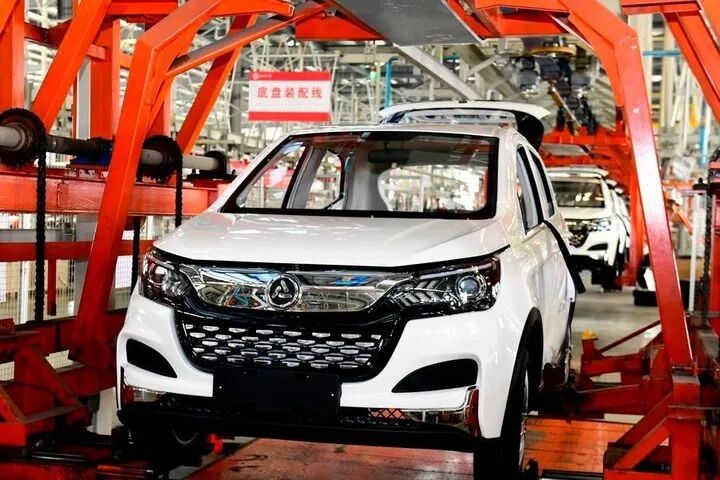
This photo taken on March 26, 2026 shows a vehicle production line in Wulian County of Rizhao City, east China's Shandong Province. (Xinhua/Guo Xulei)
Third, the report argues that China is exporting its industrial overcapacity to Europe. It claims that exporting overcapacity is a sign of China's economic weakness and that without such exports, China would be unable to "absorb" this capacity and face a crisis.
In fact, the notion that China's development depends heavily on exports is something of an illusion. According to World Bank data, China's exports accounted for only about 19 percent of its GDP in 2023 -- a share far lower than that of Germany (43 percent) or France (34 percent). Similarly, the claim that China is exporting industrial overcapacity is highly questionable. In 2024, China produced over 12 million new energy vehicles but exported only around 2 million of them -- about one-sixth of its total output. By contrast, Germany exports about 80 percent of the cars it produces. Moreover, China remains a critical market for the German automotive industry, aviation and other strategic sectors. So, by the ratio of output to exports, Europe appears to be exporting more overcapacity to the rest of the world than China does. Comparing the degree to which Chinese and European industrial production depends on international markets, it is difficult to conclude that China is more vulnerable.
Finally, the report offers the following recommendation for EU policy towards China: adopt "leverage-based diplomacy." In other words, Europe should not just defend itself but go on the "offensive." For example, the report claims that China remains heavily dependent on Europe's high-income market, particularly for exports of high-end manufactured goods. Therefore, the EU should not be afraid to strike back, because "the cost of inaction is higher than the cost of retaliation." The report also recommends that the EU stop focusing only on its own weaknesses, and instead protect and create technological "chokepoints" that China depends on -- such as advanced semiconductor equipment, biotechnology or specialized industrial software.
In reality, some Europeans tend to overestimate their own capabilities while underestimating those of others. The classical British economist David Ricardo famously explained that both parties benefit from international trade, and the importing side can obtain goods at a lower cost than it would take to produce them at home. The relationship between China and Europe in electric vehicles is a case in point. If European consumers are denied access to Chinese-made EVs, it is European consumers who lose out -- Chinese manufacturers still have access to larger global markets. When Europeans realize that consumers elsewhere in the world can buy high-quality Chinese-made EVs while they themselves cannot -- simply because of arbitrary rules imposed by their own rulers -- one can imagine how they might react. Similarly, if some Europeans fantasize about strangling China's technology development by controlling exports of advanced technologies, what will those European companies survive on once China is forced to develop those products itself -- and succeeds?
ILLUSION OF "FRAGILITY" AND REALITY OF "RESILIENCE"
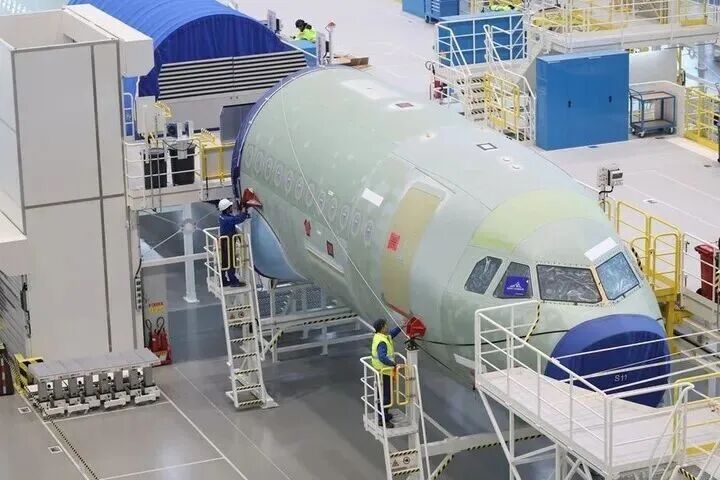
Staff members work at Airbus' second A320 family final assembly line in Tianjin, north China, Nov. 17, 2025. (Airbus/Handout via Xinhua)
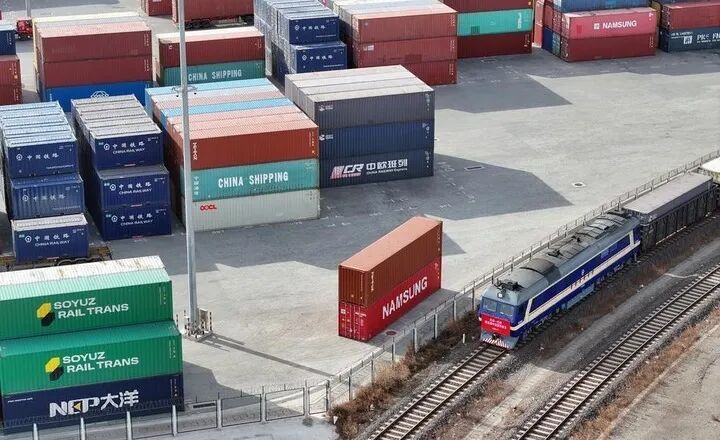
An aerial drone photo taken on Jan. 19, 2026 shows the first cross-Caspian Sea China-Central Asia freight train departing from north China's Tianjin Municipality. (Xinhua/Li Ran)