媒体聚焦 | 嵇先白: 架起太平洋之桥

0712fce54e0b62d2b8f18b02f7b9e4bb.png

本文为作者8月2日‑21日随中国人民大学区域国别研究院调研团赴巴西、智利实地调研后的评论文章。团队调研足迹覆盖里约热内卢、巴西利亚、圣保罗、坎皮纳斯、桑托斯以及智利圣地亚哥。文章聚焦拉美国家的太平洋战略选择,面对美国强化美洲霸权、将港口、关键矿产、供应链拉入大国博弈的现实,拉美国家亟需拓展多元制度选项。原文Bridging the Pacific刊发于《中国日报》8月20日全球版。


作者

嵇先白
中国人民大学区域国别研究院
南亚东南亚所所长
国际关系学院副教授

在美国重拾门罗主义、谋求主导西半球事务的背景下,拉美对多元国际合作的诉求日益上升,太平洋成为其对外拓展的重要战略方向。2026 年中国承办 APEC 领导人会议,为拉美深度嵌入亚太合作体系创造窗口机遇。
亚洲与拉美经济禀赋高度互补。拉美拥有铜、锂、农产品等资源优势,亚洲拥有庞大市场、制造能力与基建数字技术,双方经济结构高度互补,跨太平洋经贸合作具备扎实基础。
智利可以充当亚太与拉美之间的制度枢纽:推动智利加入《区域全面经济伙伴关系协定》(RCEP),同时推进中国加入《数字经济伙伴关系协定》(DEPA),实现两大方向双向扩容,助力亚太自贸区愿景落地,同时加快南方共同市场与中国的贸易磋商。
需注意的是,美墨加协定中的限制性条款,或成为掣肘拉美对外经济自主的工具。拉美应抓机遇构筑更为完备的跨太平洋经贸架构,避免被自身外交经济自主权被协定挤压。太平洋不只是贸易航道,更是拉美自主对外选择的战略空间。
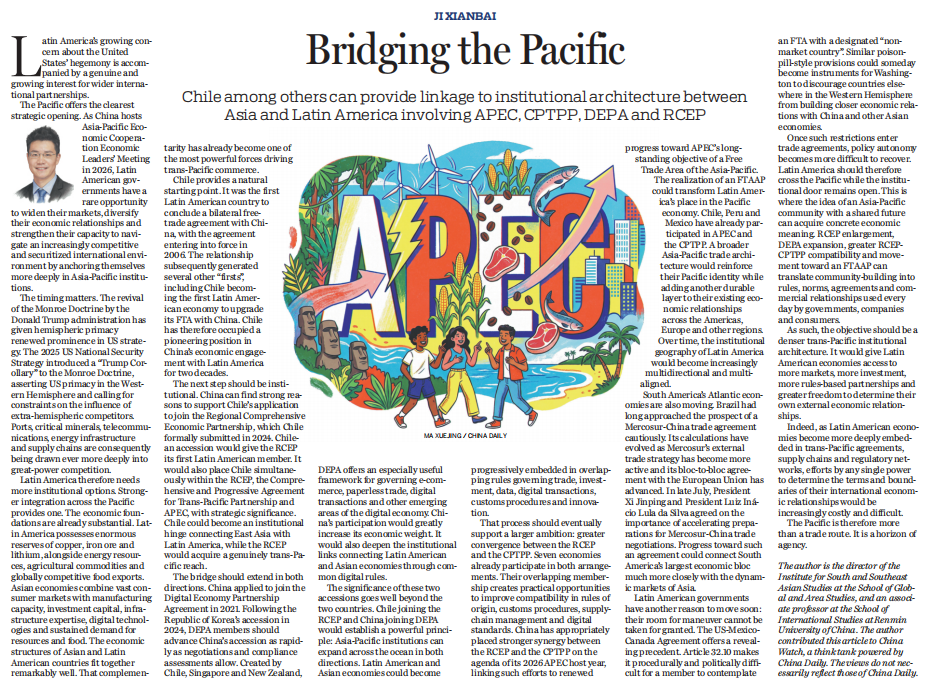
Chile among others can provide linkage to institutional architecture between Asia and Latin America involving APEC, CPTPP, DEPA and RCEP.
Latin America's growing concern about the United States' hegemony is accompanied by a genuine and growing interest for wider international partnerships.
The Pacific offers the clearest strategic opening. As China hosts Asia-Pacific Economic Cooperation Economic Leaders' Meeting in 2026, Latin American governments have a rare opportunity to widen their markets, diversify their economic relationships and strengthen their capacity to navigate an increasingly competitive and securitized international environment by anchoring themselves more deeply in Asia-Pacific institutions.
The timing matters. The revival of the Monroe Doctrine by the Donald Trump administration has given hemispheric primacy renewed prominence in US strategy. The 2025 US National Security Strategy introduced a "Trump Corollary" to the Monroe Doctrine, asserting US primacy in the Western Hemisphere and calling for constraints on the influence of extra-hemispheric competitors. Ports, critical minerals, telecommunications, energy infrastructure and supply chains are consequently being drawn ever more deeply into great-power competition.
Latin America therefore needs more institutional options. Stronger integration across the Pacific provides one. The economic foundations are already substantial. Latin America possesses enormous reserves of copper, iron ore and lithium, alongside energy resources, agricultural commodities and globally competitive food exports. Asian economies combine vast consumer markets with manufacturing capacity, investment capital, infrastructure expertise, digital technologies and sustained demand for resources and food. The economic structures of Asian and Latin American countries fit together remarkably well. That complementarity has already become one of the most powerful forces driving trans-Pacific commerce.
Chile provides a natural starting point. It was the first Latin American country to conclude a bilateral free-trade agreement with China, with the agreement entering into force in 2006. The relationship subsequently generated several other "firsts", including Chile becoming the first Latin American economy to upgrade its FTA with China. Chile has therefore occupied a pioneering position in China's economic engagement with Latin America for two decades.
The next step should be institutional. China can find strong reasons to support Chile's application to join the Regional Comprehensive Economic Partnership, which Chile formally submitted in 2024. Chilean accession would give the RCEP its first Latin American member. It would also place Chile simultaneously within the RCEP, the Comprehensive and Progressive Agreement for Trans-Pacific Partnership and APEC, with strategic significance. Chile could become an institutional hinge connecting East Asia with Latin America, while the RCEP would acquire a genuinely trans-Pacific reach.
The bridge should extend in both directions. China applied to join the Digital Economy Partnership Agreement in 2021. Following the Republic of Korea's accession in 2024, DEPA members should advance China's accession as rapidly as negotiations and compliance assessments allow. Created by Chile, Singapore and New Zealand, DEPA offers an especially useful framework for governing e-commerce, paperless trade, digital transactions and other emerging areas of the digital economy. China's participation would greatly increase its economic weight. It would also deepen the institutional links connecting Latin American and Asian economies through common digital rules.
The significance of these two accessions goes well beyond the two countries. Chile joining the RCEP and China joining DEPA would establish a powerful principle: Asia-Pacific institutions can expand across the ocean in both directions. Latin American and Asian economies could become progressively embedded in overlapping rules governing trade, investment, data, digital transactions, customs procedures and innovation.
That process should eventually support a larger ambition: greater convergence between the RCEP and the CPTPP. Seven economies already participate in both arrangements. Their overlapping membership creates practical opportunities to improve compatibility in rules of origin, customs procedures, supply-chain management and digital standards. China has appropriately placed stronger synergy between the RCEP and the CPTPP on the agenda of its 2026 APEC host year, linking such efforts to renewed progress toward APEC's long-standing objective of a Free Trade Area of the Asia-Pacific.
The realization of an FTAAP could transform Latin America's place in the Pacific economy. Chile, Peru and Mexico have already participated in APEC and the CPTPP. A broader Asia-Pacific trade architecture would reinforce their Pacific identity while adding another durable layer to their existing economic relationships across the Americas, Europe and other regions. Over time, the institutional geography of Latin America would become increasingly multidirectional and multi-aligned.
South America's Atlantic economies are also moving. Brazil had long approached the prospect of a Mercosur-China trade agreement cautiously. Its calculations have evolved as Mercosur's external trade strategy has become more active and its bloc-to-bloc agreement with the European Union has advanced. In late July, President  Xi Jinping and President Luiz Inácio Lula da Silva agreed on the importance of accelerating preparations for Mercosur-China trade negotiations. Progress toward such an agreement could connect South America's largest economic bloc much more closely with the dynamic markets of Asia.
Latin American governments have another reason to move soon: their room for maneuver cannot be taken for granted. The US-Mexico-Canada Agreement offers a revealing precedent. Article 32.10 makes it procedurally and politically difficult for a member to contemplate an FTA with a designated "non-market country". Similar poison-pill-style provisions could someday become instruments for Washington to discourage countries elsewhere in the Western Hemisphere from building closer economic relations with China and other Asian economies.
Once such restrictions enter trade agreements, policy autonomy becomes more difficult to recover. Latin America should therefore cross the Pacific while the institutional door remains open. This is where the idea of an Asia-Pacific community with a shared future can acquire concrete economic meaning. RCEP enlargement, DEPA expansion, greater RCEP-CPTPP compatibility and movement toward an FTAAP can translate community-building into rules, norms, agreements and commercial relationships used every day by governments, companies and consumers.
As such, the objective should be a denser trans-Pacific institutional architecture. It would give Latin American economies access to more markets, more investment, more rules-based partnerships and greater freedom to determine their own external economic relationships.
Indeed, as Latin American economies become more deeply embedded in trans-Pacific agreements, supply chains and regulatory networks, efforts by any single power to determine the terms and boundaries of their international economic relationships would be increasingly costly and difficult.
The Pacific is therefore more than a trade route. It is a horizon of agency.

文章来源: 《中国日报》8月20日全球版
排版:宋婷婷
网页编辑:朱维肖
审核:嵇先白、宋婷婷