



The Academy of Regional and Country Studies is Established!
2026-01-20
browse:581
2026-01-20
January 9thLooking Ahead to 2024: World Order and Regional Dynamics Amidst a Century of Unprecedented Changes
Academic Symposium & Inauguration of the Institute of Regional and Country Studies, Renmin University of China
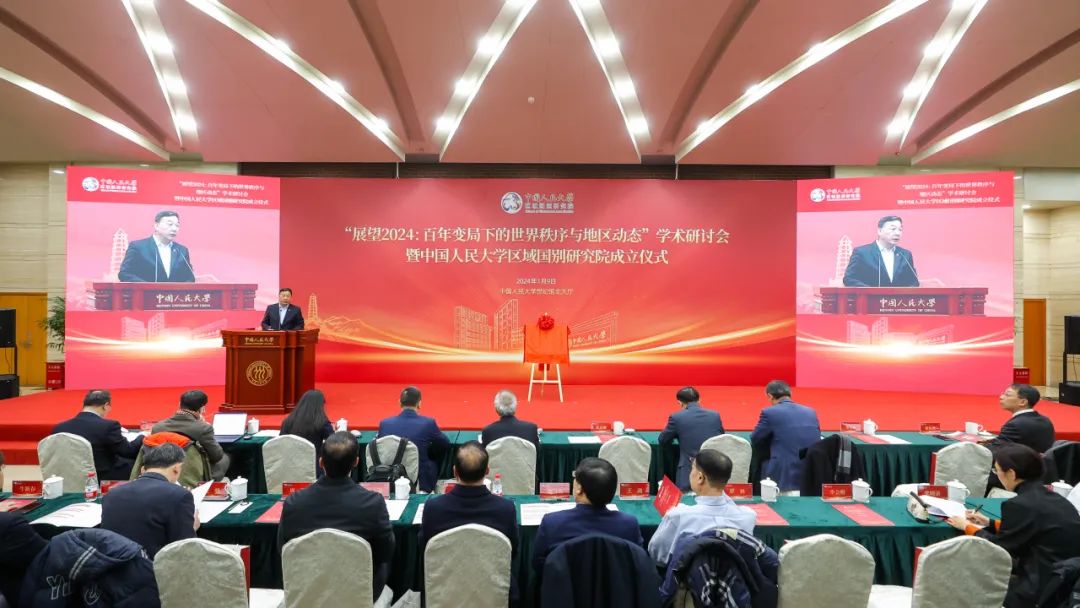
The Inauguration of the Institute of Regional and Country Studies, a school-level institution of Renmin University of China, was successfully held on January 9th at the university.
Ai Ping, Vice President of the China International Exchange Association and former Vice Minister of the International Department of the Communist Party of China Central Committee, and Zhang Donggang, Secretary of the CPC Renmin University of China Committee, attended the ceremony and delivered speeches. Yue Xiaoyong, Special Envoy of the Ministry of Foreign Affairs of the People's Republic of China for Afghan Affairs, Yang Dan, President of Beijing Foreign Studies University, Jiang Feng, former Secretary of the CPC Shanghai International Studies University Committee, Ning Qi, Deputy Secretary of the CPC Peking University Committee and Vice President, and Zheng Shuiquan, Deputy Secretary of the CPC Renmin University of China Committee, were present. Wang Yi, Vice President of Renmin University of China, hosted the ceremony.
In his speech, Zhang Donggang pointed out that regional and country studies are not only an academic discipline of universities but also a discipline of great powers. By systematically integrating existing teaching and research platforms and institutions related to regional and country studies to establish the Institute of Regional and Country Studies, Renmin University of China has taken concrete steps to thoroughly study and implement Xi Jinping Thought on Diplomacy and the spirit of the important speeches made by General Secretary Xi Jinping during his inspection tour of the university. It also embodies the inherent requirement of fulfilling the fundamental task of fostering virtue through education and constructing an independent Chinese knowledge system of regional and country studies, as well as a proactive commitment to enhancing the strategic autonomy and initiative in diplomacy and actively serving the new situation of major-country diplomacy with Chinese characteristics. He expressed the hope that the institute will uphold its distinctive characteristics, always adhere to the guidance of Xi Jinping Thought on Diplomacy, align with the goals and tasks of Chinese-style modernization, and promote the high-quality development of a new type of international relations. It should demonstrate its mission and responsibility, produce unique and iconic achievements, and provide answers to the questions raised by China, the world, the people, and the times. It is also expected to blaze a new path in research, develop regional and country studies with Chinese characteristics, style, and ethos, and create a more favorable international environment and provide more solid strategic support for comprehensively advancing the great cause of building a strong country and national rejuvenation through Chinese-style modernization.
Ai Ping noted in his speech that Renmin University of China has a long history and profound accumulation in the field of regional and country studies. The establishment of the Institute of Regional and Country Studies comes at the right time and has broad prospects for development. It will provide intellectual support and talent resources for serving China's diplomacy in the new era, implementing the "Three Global Initiatives", promoting mutual learning among civilizations, and building a community with a shared future for mankind. He hoped that the institute will conduct scientific coordination, optimize its mechanism, take organized scientific research as the starting point, further promote in-depth interdisciplinary integration, better highlight the policy, academic, and social values of regional and country studies, strive to construct a knowledge system and theoretical framework of regional and country studies with Chinese characteristics and world-class standards, develop into a "think tank for the new era of a major country" with global early warning and analytical capabilities, and contribute to cultivating and delivering high-quality practical and research-oriented talents for China's foreign exchanges.
Yue Xiaoyong, Yang Dan, and Ning Qi delivered keynote speeches focusing on constructing an independent Chinese knowledge system of regional and country studies and advancing the new situation of major-country diplomacy with Chinese characteristics.
Yue Xiaoyong stated that the world, our times, and history are undergoing unprecedented changes. The new situation and goals require us to further understand the external world, accurately grasp the evolution of the international situation and pattern, conduct more comprehensive and in-depth research on various countries and regions around the world, and formulate precise regional and country strategies adapted to major-country diplomacy with Chinese characteristics in the new era. The establishment of the Institute of Regional and Country Studies at Renmin University of China will surely exert great potential in constructing an independent Chinese knowledge system of regional and country studies, cultivating interdisciplinary and compound professionals, and researching and solving major theoretical and practical issues in foreign affairs. It will provide strong support for addressing the key and difficult problems in China's diplomacy in the new era and make new and greater contributions to creating a new situation in major-country diplomacy with Chinese characteristics.
Yang Dan pointed out that regional and country studies are a discipline of great powers serving the rise of major countries, a discipline of universities promoting interdisciplinary integration and innovation, and a distinctive discipline of Renmin University of China. As an interdisciplinary subject, regional and country studies place higher requirements on universities' academic capabilities, governance capabilities, service capabilities, innovation capabilities, and global perspectives. She hoped that the institute will base itself on China's realities, solve China's problems, refine Chinese expressions, pool Chinese wisdom, enhance the scientific nature, predictability, initiative, and creativity of academic research, and provide high-quality services for major-country diplomacy with Chinese characteristics.
Ning Qi said that conducting regional and country studies requires in-depth research on key countries, analyzing and summarizing the representative characteristics and issues of different countries, extracting common and differentiated issues in regions, explaining the in-depth connections between history and reality, and promoting the inclusive coexistence and mutual respect of diverse cultures. The establishment of the Institute of Regional and Country Studies at Renmin University of China will surely inject strong impetus into constructing an independent Chinese knowledge system of regional and country studies and contribute to cultivating high-quality talents in regional and country studies. These talents should possess profound attainments in both Eastern and Western cultures, a spirit of innovation, solid academic foundation, international vision, and patriotic feelings, and be able to play an important role in dialogues, exchanges, and cooperation with different civilizations and disciplines.
Wang Yi hosted the ceremony.
Ai Ping, Zhang Donggang, Yue Xiaoyong, Yang Dan, Jiang Feng, Ning Qi, Zheng Shuiquan, and Zhai Kun, Deputy Director of the Institute of Area Studies, Peking University, unveiled the plaque for the Institute of Regional and Country Studies, Renmin University of China, and issued appointment letters to senior researchers.
Following the inauguration ceremony, the academic symposium themed "Looking Ahead to 2024: World Order and Regional Dynamics Amidst a Century of Unprecedented Changes" was held.
Jiang Feng, former Secretary of the CPC Shanghai International Studies University Committee, Zhou Qi, Dean of the Institute of Global Governance and Development at Renmin University of China, Zhai Kun, Deputy Director of the Institute of Area Studies at Peking University, Luo Lin, Dean of the Institute of Country and Area Studies at Beijing Language and Culture University, and Zhai Dongsheng, Dean of the Institute of Regional and Country Studies and Deputy Dean of the School of International Relations at Renmin University of China, delivered on-site speeches on "Prospects for the World Political and Economic Order in 2024". Liu Hongwu, Dean of the Institute of African Studies at Zhejiang Normal University, delivered a speech via video link. The session was hosted by Zhang Xiaojing, Secretary of the CPC Committee of the School of International Relations at Renmin University of China.
Wu Hao, Dean of the School of Northeast Asian Studies at Jilin University, Liu Changming, Dean of the School of Northeast Asian Studies at Shandong University, Li Zhiqiang, Dean of the School of International Relations at Sichuan University, Wang Zhan, Distinguished Professor at Huazhong Agricultural University, and Wang Wen, Executive Dean of the Chongyang Institute for Financial Studies at Renmin University of China, delivered speeches on "Analysis of Regional Situations Amidst a Century of Unprecedented Changes". The session was hosted by Chen Fang, Dean of the School of Foreign Languages and Deputy Dean of the Institute of Regional and Country Studies at Renmin University of China.
In his summary of the symposium, Yang Guangbin, Dean of the School of International Relations at Renmin University of China, emphasized the disciplinary characteristics of regional and country studies, which lie in the organic integration of micro methods and macro theories. At the micro level, field research plays a crucial role in gaining an in-depth understanding of countries around the world, a role that cannot be replaced by artificial intelligence. At the macro level, the core of regional and country studies is to understand institutional changes triggered by the world market and political trends of thought.
Relevant officials from government departments including the Office of the Central Commission for Foreign Affairs, representatives from sister universities, and representatives from researcher teams attended the inauguration ceremony.